
Flower Forest Level 88 Answer
The yellow paper solution for Flower Forest level 88 is D, G, E, A: slide the squares together until their white strokes join into letters. Assemble the block before entering anything on the parchment below. Finish the four choices with the flower control.
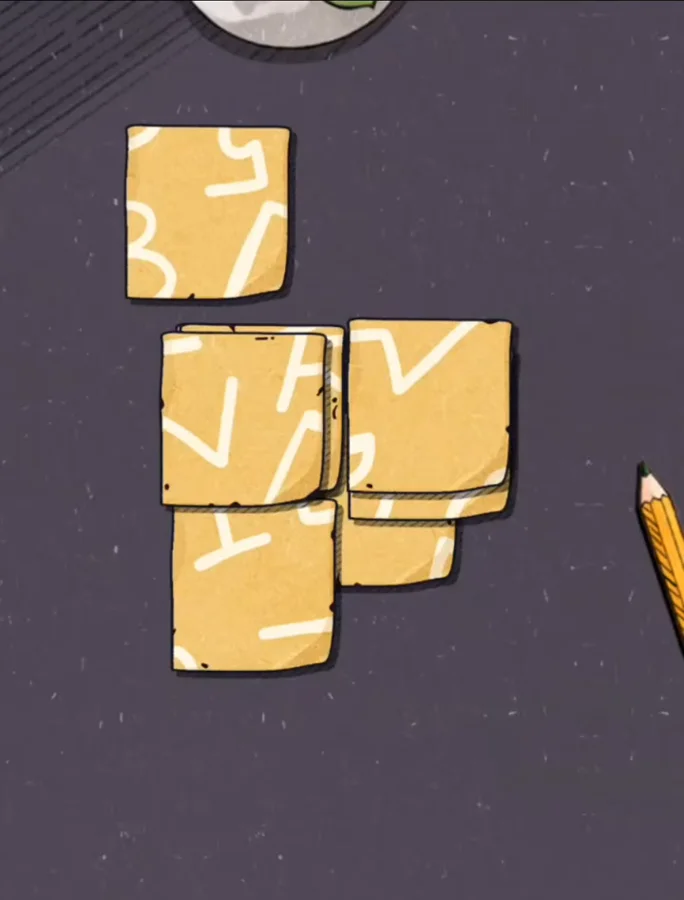
Yellow paper squares lie in a loose, overlapping group on a dark purple tabletop. Thick white curves and angled lines cross their faces, with some marks cut off at the paper edges. One square sits apart above the main cluster. A sharpened yellow pencil rests along the right edge, and part of a pale round object is cropped at the top.
Gather the Yellow Squares
Look for white strokes that end at a paper edge instead of trying to name each isolated mark. Bringing those edges together lets the separate scraps contribute to one complete clue.
- Inspect the yellow papers, including the square sitting above the overlapping group.
- Slide the squares toward one another to gather them into a single block.
- Check the white marks across the joined papers and identify D, G, E and A.
- Tap D, G, E, A, and finish by pressing the flower button.
At first, one square can show the end of a curve while another shows a straight piece of a different letter. Those fragments look meaningful enough to encourage an early guess, but their edges interrupt the outlines. As the papers come together, compare the white line on one side of a join with the line beside it. The assembled block is what turns the marks into readable capitals.
Work on the group as a whole instead of treating the most exposed top square as a separate puzzle. Overlapping corners in the starting picture can hide some of the paper beneath, so a quick count of visible faces is not a reliable answer key. Move the squares together and inspect the resulting strokes before returning to the parchment. Your goal is a coherent letter clue, rather than a tidy pile with several unreadable fragments still separated.
Video: level 88 yellow letter papers from start to finish
Use the walkthrough to follow the paper squares as they are brought together and compare the joined white marks. It continues from the completed clue to the letter choices and the flower in its glass dome.

Join Broken White Strokes
The yellow background separates the movable papers from the pale writing on them. Read the white strokes as the actual clue, following them across the joins after assembly. A curve cut by a square edge can be only part of a letter, so the starting layout encourages false readings. Once the papers form their block, the required sequence is D followed by G, then E, then A.
Keep that sequence as a four letter result, even though the scene contains more than four visible pieces and many individual line fragments. A scrap of a curve is not an extra C, and an isolated straight mark does not automatically mean I. The complete shapes matter more than small pieces you could name in several ways. The order also stays DGEA, rather than becoming ADEG when you transfer the result to the alphabetically arranged grid.
Fragments That Look Complete
If the papers still look like unrelated symbols, check their arrangement before changing the answer. Loose squares leave parts of the white drawing disconnected, and the square above the main cluster is easy to overlook. Gather the full group so that the clue can be read across the block. The pencil at the side identifies the tabletop setting, but the solution comes from assembling the marked papers.
Another trap is recognizing the four letters correctly and then entering them in alphabetical order. The grid keeps its regular arrangement, which can pull your attention toward A before the other letters. Hold the clue order in mind and locate each choice individually. The last A is still needed even though D, G and E have already disappeared from the parchment after your first three taps.
Frequently Asked Questions
What is the answer for Flower Forest level 88?
D, G, E, A is the yellow papers answer, completed with the flower control. Slide the scattered squares into one block so that their white markings form readable letters. The finished shapes provide four choices; neither the number of papers nor the order printed on the parchment supplies the solution.
How do the yellow papers become a clue?
Their white strokes connect when the paper squares are moved together. An edge that cuts through a curve in the starting scene can meet another part of the same drawing in the assembled block. Look across the joined pieces for whole letters instead of assigning a separate letter to each square.
Is the yellow pencil part of the level 88 answer?
The answer is read from the white marks on the papers, rather than from the pencil. Focus your moves on gathering those yellow squares into their block. The pencil sits along the right side of the table, while the useful changes happen where the paper edges and their interrupted strokes come together.
Why does entering A, D, E, G fail?
A, D, E, G rearranges the paper clue into alphabetical order. The required sequence begins at D, continues with G and E, and ends at A. Recognizing the correct set is insufficient if you change its order, so carry the assembled result directly to the parchment without sorting it.
What should I check before pressing the flower?
Check that your four paper letters were entered as D, G, E, A. Each selected choice disappears, giving you a way to track progress but not to prove the order. If you guessed from loose strokes before joining the block, return to the complete clue before trying to finish the level.
Read next



The letter order for every level is in one table on the Flower Forest answers for all levels page. Official store links are on the download page.